Marine Laundry Equipment: A Specification Guide for Superyachts
Specifying commercial marine laundry equipment for superyachts — washers, condensing dryers, ironing stations, and space planning for the full charter workload.
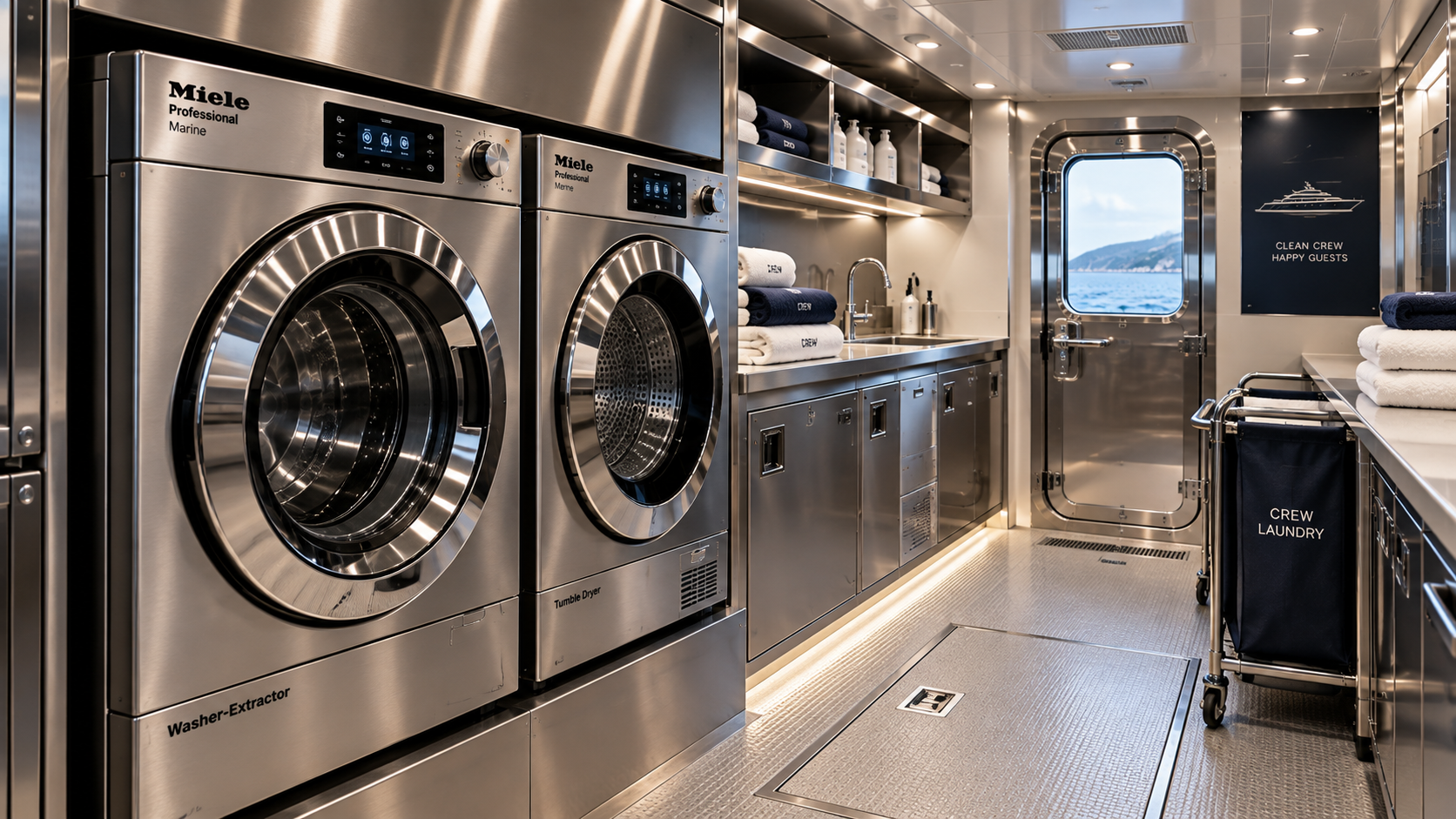
The laundry on a superyacht is the department that guests never see and never forget — when it works correctly, linens arrive perfectly pressed and guest uniforms are returned unwrinkled within hours. When it fails, the impact cascades immediately into guest experience. This guide covers the specification, selection and operation of marine laundry equipment for vessels from 30 metres upward.
The Scale of the Task
A 45-metre superyacht running a full charter generates, on a typical day, linen changes for eight to twelve guest cabins, twelve to twenty crew uniforms, sixty to eighty bath and pool towels, several tablecloth and napkin sets, and a rotation of guest robes. This is commercial laundry volume, and it requires commercial marine laundry equipment to process it without falling behind. Domestic machines, regardless of quality, are not built for continuous-duty operation at this frequency.
Washing Machines for Superyachts
Front-loading commercial washers are the industry standard for marine laundry equipment applications. Their sealed drum geometry tolerates vessel motion without unbalancing; they consume significantly less water per cycle than top-loaders; and their mechanical design is suited to high-cycle-frequency operation. The key specification parameters are:
- Drum capacity: 8–18 kg for large yachts; paired or stacked units to allow concurrent programmes
- Water consumption: Inverter-drive machines with automatic load sensing achieve 40–55 litres per cycle — critical when the vessel is running on a limited watermaker output
- Programme range: Delicate, wool, cotton, heavy soil, express, and sanitise cycles must all be available
- Motor type: Inverter (variable frequency) motors reduce power peaks and extend machine life compared with direct-drive alternatives
- Anti-vibration mounts: High-speed spin cycles generate forces that transmit through the hull; properly rated anti-vibration feet are a required specification item for all marine laundry equipment
Tumble Dryers for Marine Environments
Condensing dryers are the only correct specification for superyacht applications. Vented dryers — which exhaust humid air to atmosphere through a duct — are impractical because they introduce salt-laden exterior air on the return stroke and require complex ducting in an already space-constrained utility. A condensing dryer closes the circuit, collecting moisture in a reservoir or drain line, and functions identically regardless of the vessel's heading or the exterior climate.
Heat-pump dryers consume 40–60% less energy than conventional resistance-element machines — a meaningful reduction in generator load over a full charter week. Moisture-sensing termination prevents over-drying and protects expensive guest linen from heat damage.
Ironing and Pressing Equipment
A professional steam ironing station is essential for the presentation standards expected at this level. For guest shirts and tablecloths, a gravity-feed upright iron with a separate boiler is the minimum specification. For pillowcases, napkins and flat sheets in volume, a flatwork ironer or rotary press dramatically reduces the time required and produces a consistently crisp result that hand-ironing cannot match at speed. Miele Professional, Electrolux Professional and Rowenta Professional are the most-specified brands in this category.
Equipment Layout and Space Planning
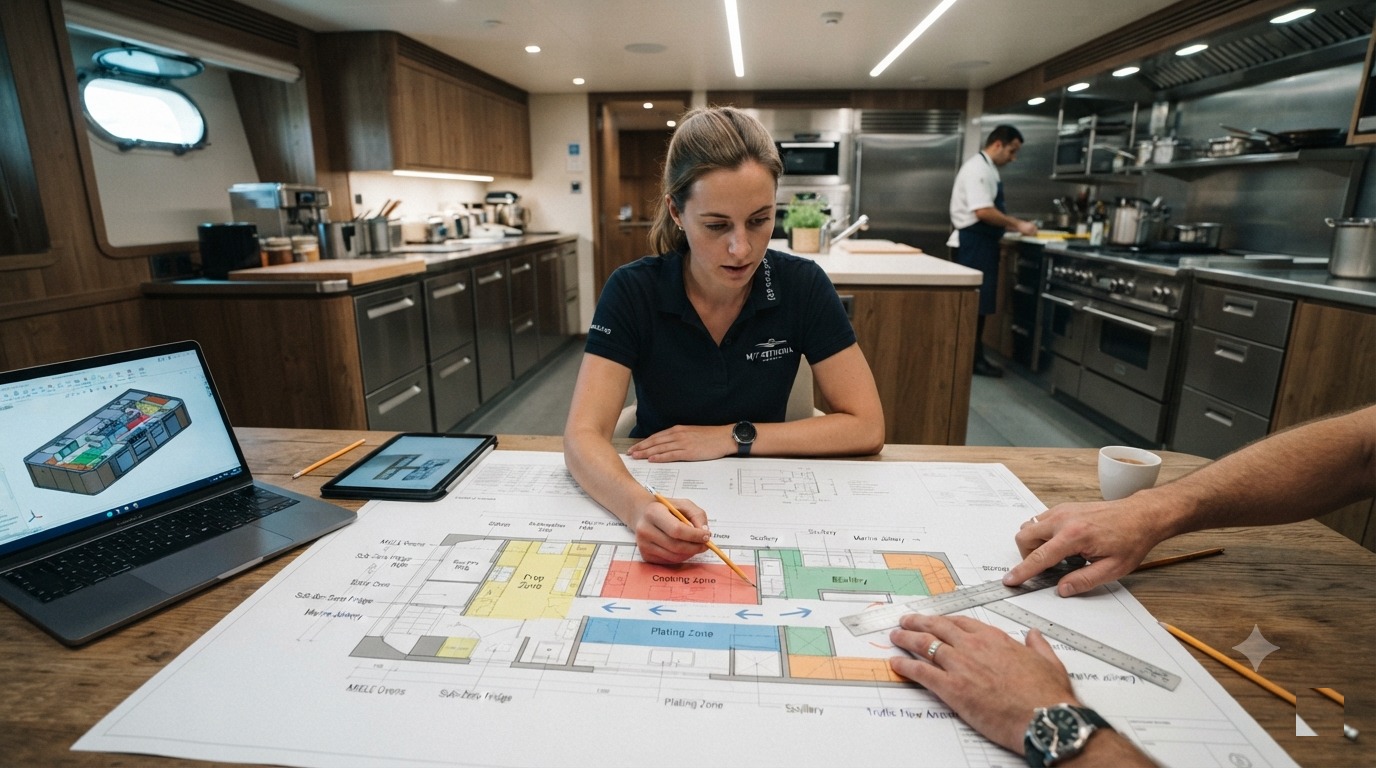
Marine laundry equipment is typically installed in a dedicated utility space adjacent to the crew corridor — away from guest areas to contain noise and vibration. Stacked washer-dryer pairs are the standard approach when floor area is limited. Ventilation must provide air changes sufficient to handle the heat and moisture output from multiple machines running concurrently. A sorting table or folding counter and wall-mounted linen storage complete the functional specification of the space.
Acoustic treatment of the laundry space — lining walls with mass-loaded vinyl or acoustic foam behind a finished panel — significantly reduces the sound transmission to adjacent crew cabins, where machines may run through the night.
Brands Specified in the Superyacht Industry
Marine laundry equipment for superyachts is dominated by a small number of commercial manufacturers with both the product ratings and the global service networks to support ocean-going applications:
- Miele Professional — thermal disinfection programmes, long machine life, widely preferred for guest linen care
- Electrolux Professional — high-capacity commercial range with marine installations globally
- Speed Queen — American commercial manufacturer, hardwearing and widely serviced in North American and Caribbean charter markets
- Girbau — European specialist with stacked solutions suited to compact marine spaces
- Primus — heavy-duty commercial machines used on larger charter yachts and expedition vessels
Water Softening and Treatment
Scale build-up is the primary cause of premature failure in marine laundry equipment operated in regions with hard water supply. A water softener fitted upstream of the laundry supply protects heating elements, drum seals and valve assemblies. Where the vessel operates on desalinated water — which is typically very soft — a softener is less critical, but a sediment filter is still recommended. Correct detergent dosing calibrated to the water hardness in use extends both machine life and linen quality.
Detergents and Chemical Storage
Commercial laundry detergents in concentrated form are more effective and more economical than domestic products. Auto-dosing systems — which dispense precise quantities of main wash detergent, fabric conditioner, and any disinfection chemical based on programme and load weight — eliminate guesswork and reduce the risk of detergent residue in guest linen. Chemical storage must comply with SOLAS requirements for hazardous material stowage aboard.
Related Services
Written by Abraham Stones, drawing on 20+ years of superyacht galley design, specification and procurement experience. All content reflects real-world project knowledge from vessels of every size.
View full profile →Apply This to Your Vessel
Every vessel is different. Speak with our specialist team to apply this guidance to your specific project — we respond to all enquiries within one business day.