MARPOL
MARPOL (Marine Pollution Prevention) is the international convention regulating discharge of food waste, oily water, sewage and garbage from vessels into the marine environment.
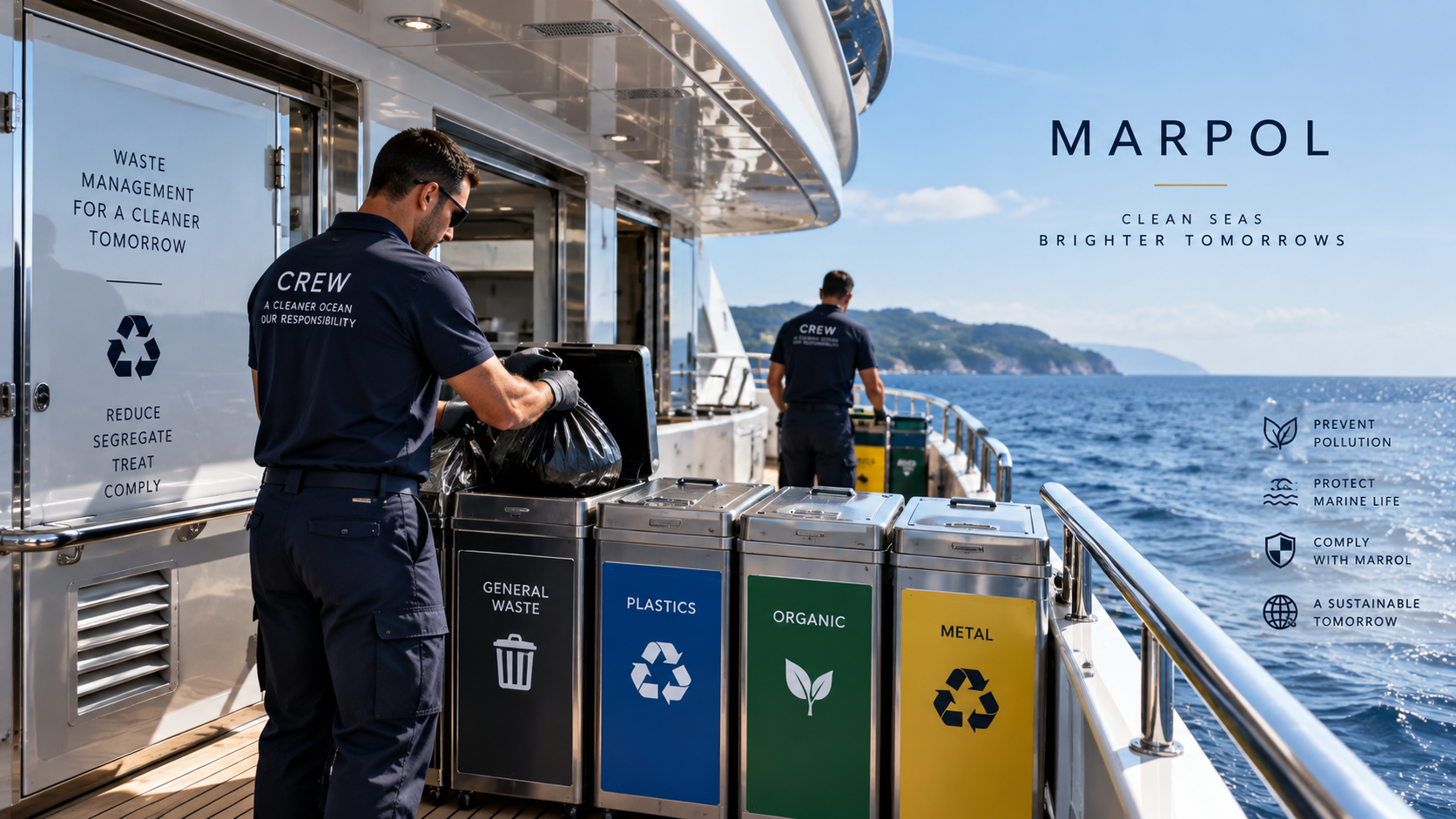
MARPOL — the International Convention for the Prevention of Pollution from Ships — is the primary international treaty governing the environmental obligations of commercial vessels and superyachts worldwide. Adopted in 1973 and amended significantly by the 1978 Protocol, MARPOL is administered by the International Maritime Organization (IMO) and applies to vessels flagged under signatory states. For superyacht operators, MARPOL compliance is not optional: it is a flag state legal obligation with direct implications for galley operations, waste management, and sea conduct.
The Six Annexes of MARPOL
MARPOL is structured into six annexes, each covering a different category of marine pollution. The annexes most directly relevant to superyacht galley operations are Annex IV and Annex V.
Annex I — Oil and Oily Mixtures
Annex I regulates the discharge of oil and oily water from machinery spaces. The 15 ppm overboard limit for bilge water is the most commonly encountered rule. While this falls outside the galley remit directly, cooking oils and galley waste water that enters bilge spaces can create an Annex I compliance problem if oil concentrations exceed the permitted level.
Annex IV — Sewage
Annex IV prohibits the discharge of untreated sewage within 12 nautical miles of land (and within special areas, at any distance without treatment). Comminuted and disinfected sewage may be discharged beyond 3 nautical miles. For most superyachts, a marine sanitation device (MSD) or holding tank system manages Annex IV compliance. The galley connection here is grey water — sink drainage from the galley, which is technically regulated by Annex IV in its broader interpretation in certain jurisdictions.
Annex V — Garbage Management (most relevant to galley operations)
Annex V is the annex with the most direct day-to-day impact on superyacht galley operations. It prohibits the discharge of all garbage into the sea, with limited exceptions for food waste. The key rules are:
- Plastics: Absolutely prohibited from discharge anywhere at sea, including mixed food waste contaminated with plastic packaging
- Food waste: May be discharged at more than 12 nautical miles from the nearest land when not in a Special Area, provided it is ground or comminuted to particles of less than 25mm. In Special Areas (Mediterranean, Baltic, Black Sea, Red Sea, Antarctic and others), food waste discharge is prohibited within 12 nautical miles even when ground
- Cooking oil: Prohibited from discharge into the sea under Annex V
- Other garbage: Paper, glass, metal, operational waste — all prohibited from sea discharge
Every vessel of 100 gross tonnage or more, and every vessel certified to carry more than 15 persons, must have a Garbage Management Plan and maintain a Garbage Record Book. The log must record every discharge, incineration, or port reception facility disposal of garbage, signed by the officer in charge.
Annex VI — Air Pollution
Annex VI regulates sulphur oxides (SOx), nitrogen oxides (NOx) and particulate matter from exhaust gases. For superyachts, the most common practical implication is the sulphur content of fuel used in Emission Control Areas (ECAs), including the North American ECA, the North Sea and Baltic ECA, and the US Caribbean ECA. Fuel used in these areas must not exceed 0.10% sulphur by mass. The galley connection is indirect but real: if the yacht operates a diesel generator or auxiliary genset for galley power, those emissions are captured under Annex VI.
MARPOL Compliance in Practice: Galley Obligations
For the superyacht galley team, MARPOL compliance translates into the following daily operational requirements:
- Waste segregation: Galley waste must be separated into food waste (potentially dischargeable under Annex V conditions), recyclables, and general garbage from the point of generation
- Cooking oil: Used cooking oil must be collected in sealed containers and transferred to a port reception facility — never discharged overboard
- Garbage Record Book entries: Every galley waste disposal event must be logged with date, time, position, description and quantity of material, and the method of disposal
- Comminution: Where food waste is to be discharged at sea under permitted conditions, a food waste comminutor (integrated into the galley waste system) must reduce particle size to less than 25mm
- Special Area awareness: The galley team must know the vessel's current position relative to Special Areas and adjust their waste disposal procedures accordingly
Port Reception Facilities
MARPOL obligates signatory ports to provide adequate reception facilities for ship-generated waste. In practice, the quality and accessibility of these facilities varies significantly by location. In Mediterranean marinas, dedicated waste collection for superyachts is well-developed. In more remote cruising grounds, the chief steward should research reception facility options prior to arrival and plan waste accumulation aboard accordingly. MARPOL Annex V does not permit discharge simply because no reception facility is available — the obligation to retain waste until proper disposal is unconditional.
Penalties and Flag State Enforcement
MARPOL violations are enforced by port state control authorities, who may inspect any vessel calling at their ports. Penalties vary by jurisdiction but include substantial fines, vessel detention, and in serious cases, criminal prosecution of the master and officers. Class societies and flag states require Garbage Management Plans to be available for inspection at any time. The Garbage Record Book must be retained for two years and produced on demand.
Related Services
This definition was written by Abraham Stones, drawing on 20+ years of superyacht galley design, specification and procurement experience.
View full profile →Have a Project in Mind?
Speak with our specialist team about your superyacht galley project — we respond to all enquiries within one business day.