
Vacuum Packer
A vacuum packer removes air from a bag around food and seals it, extending shelf life, enabling sous vide cooking, and facilitating safe long-term frozen storage.
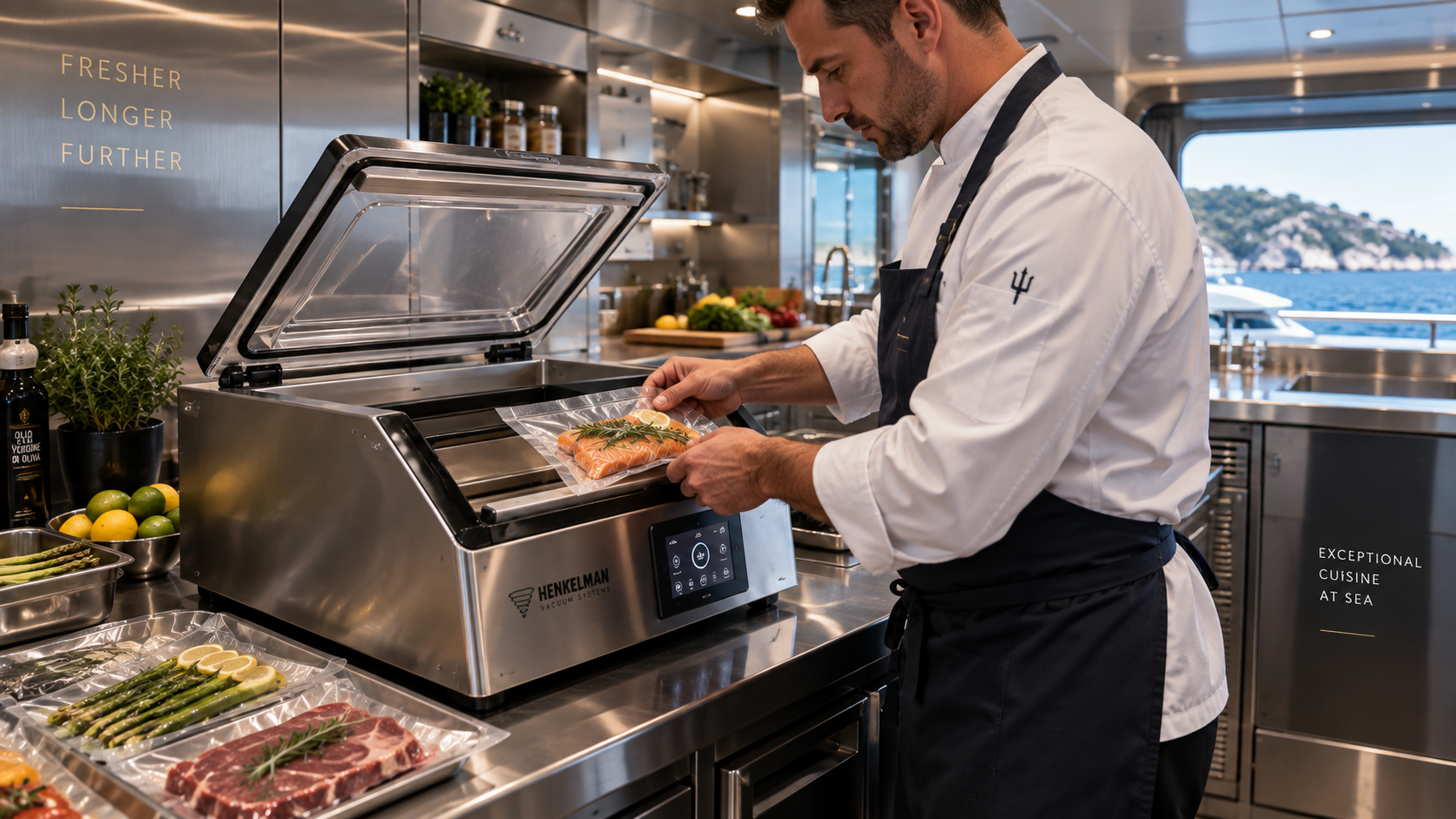
A vacuum packer draws air from a food-grade pouch surrounding a food product and heat-seals the bag in an airtight configuration. The result is a package from which aerobic bacteria, oxidation and moisture exchange have been substantially eliminated — making the vacuum packer one of the most productive pieces of equipment in a superyacht galley.
How Vacuum Packing Works
The machine places the open end of a filled pouch over a heated sealing bar — either within a sealed chamber (chamber machines) or across an external suction nozzle (bar-type machines). A vacuum pump evacuates the air to a defined negative pressure, typically 99–99.9% vacuum, after which the sealing bar activates and heat-bonds the bag closed. The entire cycle takes 20–45 seconds depending on machine class and product density.
Applications on a Superyacht
- Extended provisioning: Vacuum-packed proteins, aged cheeses, cured meats and prepared produce can be stored for two to three times the conventional refrigerated shelf life — critical when provisioning for passages of seven or more days in remote locations where resupply is uncertain or expensive.
- Sous vide cooking: Vacuum-sealed bags allow precise temperature cooking in an immersion circulator water bath, producing proteins and vegetables with controlled texture and moisture retention. Sous vide is increasingly standard technique in charter yacht galleys for service consistency across multiple covers.
- Frozen storage: Airtight packing prevents freezer burn on items held for extended periods, protecting provisioning stock integrity on long voyages and protecting against costly waste.
- Accelerated marinating: The vacuum environment opens the cellular structure of the food, accelerating marinade penetration — what takes twelve hours at atmospheric pressure is achieved in one to two hours under vacuum.
- Storage efficiency: Flat, vacuum-packed portions stack more efficiently in refrigerators and freezers, increasing usable storage capacity in the space-constrained refrigeration typical of a yacht galley.
- Portion control and pre-prep: Individual portions can be sealed and labelled in advance of charter, reducing preparation time and galley congestion during busy service periods.
Chamber vs Bar-Type Vacuum Packers
Chamber vacuum packers — in which the entire bag and its contents sit inside a sealed chamber during evacuation — are the correct specification for a professional superyacht galley. They achieve a more consistent vacuum level, can pack liquids and marinades without them boiling out of the bag, and are built for continuous-duty operation across a full charter week. Bar-type (external nozzle) vacuum packers are lighter and cheaper but limited to drier products and lower cycle volumes. For a working galley producing multiple bags per service, a chamber machine is the appropriate specification.
Machine Selection Criteria
Key parameters when specifying a vacuum packer for a superyacht galley are:
- Chamber dimensions: Must accommodate the largest item being packed, including whole fish fillets, full roasting joints and large charcuterie pieces
- Pump capacity: Measured in m³/hour, this determines the speed and depth of vacuum achieved and the maximum cycle frequency the machine can sustain
- Seal bar width and count: Wider and double seal bars handle larger bag formats and improve seal reliability
- Construction: Marine environments demand stainless steel chamber and lid, with gaskets and seals replaceable without specialist tooling
Commercial machines from Henkelman, Multivac, Henkovac and Boxer are regularly specified in professional superyacht galley applications. All offer models with the cycle endurance required for charter operation.
Bags and Consumables
Vacuum packing bags must be food-safe, rated for the temperature range of their application — including boiling water for sous vide and sub-zero for frozen storage — and compatible with the machine's sealing bar temperature and width. Structured (embossed) bags are used with bar-type machines; smooth bags with chamber machines. Stocking a range of bag sizes from 200×300mm to 400×600mm covers the majority of applications found in a superyacht galley.
Related Services
This definition was written by Abraham Stones, drawing on 20+ years of superyacht galley design, specification and procurement experience.
View full profile →Have a Project in Mind?
Speak with our specialist team about your superyacht galley project — we respond to all enquiries within one business day.